
theology and film
Disney Images
Nikola Knezevic
The Walking Dead as Paradigm and Simulacrum of the Apocalypse (Part I)
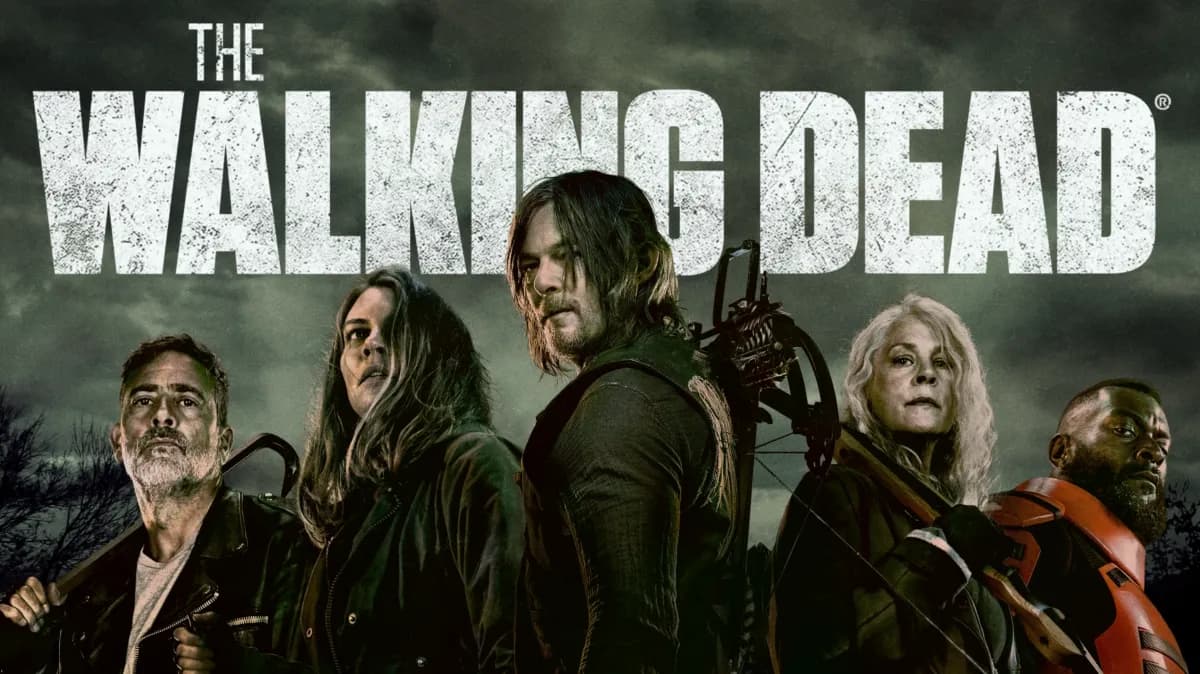
A legendary television series, The Walking Dead, was far more than a conventional post-apocalyptic survival narrative situated within the familiar conventions of the zombie genre. Rather, it functioned as a paradigm and simulacrum of tragic, agonizing reality, exposing the eschatological fragility of late modern civilization and dramatizing the impending collapse of civilization. What appears as popular entertainment reveals itself, upon closer examination, as a theological-political allegory of the contemporary world.
Apocalypse as Discontinuity
A legendary television series, The Walking Dead, was far more than a conventional post-apocalyptic survival narrative situated within the familiar conventions of the zombie genre. Rather, it functioned as a paradigm and simulacrum of tragic, agonizing reality, exposing the eschatological fragility of late modern civilization and dramatizing the impending collapse of civilization. What appears as popular entertainment reveals itself, upon closer examination, as a theological-political allegory of the contemporary world.
The apocalyptic motif is never passé precisely because apocalypse interrupts. It ruptures the continuity of everyday life and disrupts the lethargic inertia fostered by consumerist modernity, which sustains the illusion of order, security, and teleological coherence. Apocalyptic imagination serves as a counterforce to the anesthetizing effects of technocratic rationality and market logic. Much like Borislav Pekić’s Rabies, which anticipates civilizational breakdown and thereby shatters the illusion of triumphant humanism, The Walking Dead destabilizes the self-assured image of modern humanity. It reveals a society already in a prodromal state, with symptoms of systemic illness evident yet denial persisting, slowly advancing toward its own abyss.
The series stages a persistent Manichaean tension between self-sacrifice and domination, solidarity and will to power. Within the collapse of social order, human cruelty surfaces with startling immediacy. In this sense, the zombie apocalypse is not the only catastrophe; rather, it unveils what was already latent within human structures of power and desire.
Mimicry, Simulacrum, and Political Theology
The apparent distance between political theology and the zombie genre dissolves when one considers the logic of mimicry. Zombies represent not life but the simulation of life, a grotesque imitation stripped of interiority. They move, consume, and persist, yet lack memory, will, emotion, and rationality. Their existence is mechanical and reduced to biological impulse, much like the majority of consumers.
In the first season, a scientist at the Centers for Disease Control explains that a retrovirus destroys the central nervous system, killing the host and subsequently reactivating only the most primitive brain functions. What remains is not a person but a shell animated by a singular drive, namely, consumption. The personality, including memory, conscience, and relational capacity, is irretrievably extinguished.
This biological metaphor carries theo-political significance. The modern subject, embedded within systems of exploitation and technocratic instrumentalization, risks a similar reduction. Socio-political structures present themselves as guarantors of sovereignty, freedom, and order, yet often transform human beings into objects, units of production, consumption, and management - the illusion of autonomy masks systemic dependency.
In this light, the walker becomes a parable of late modern humanity: animated and functional, yet deprived of transcendence and moral orientation. What appears as vitality is, in fact, a spiritual exhaustion. The relentless pursuit of profit mirrors the zombie’s insatiable hunger. Both operate within closed circuits of self-preservation devoid of higher telos.
Such a reduction of the human to mechanical necessity recalls existentialist diagnoses of absurdity. Human life becomes mere breath, echoing Beckett’s minimalism, a cry suspended between meaning and silence. The absence of an eschatological horizon compounds the weight of absurdity. Despair, as patristic theology reminds us, is not merely psychological but ontological in nature. It is the loss of orientation toward redemption and salvation.
Hope as Eschatological Counterforce
The series, however, does not culminate in nihilism. A critical reading reveals hope as its subterranean theological impulse. This hope is not Promethean self-assertion, nor the deferred expectation of Beckett’s Godot, nor Nietzsche’s critique of hope as the prolongation of suffering. Rather, it approximates an eschatological hope grounded in the possibility of renewal.
Within Christian theology, hope is not illusion but anticipation, a proleptic participation in a redeemed future. Without eschatological hope, faith collapses into resignation. Without hope, existence dissolves into nihilism. The moral energy of the series, its insistence on preserving community, protecting the vulnerable, and sustaining solidarity, derives from this implicit eschatological orientation.
Even when meaning appears absent, the characters continue to act as if meaning remains possible. Such action constitutes resistance against despair. Hope becomes not sentiment but praxis.
Authority, Power, and the False Messiah
The conflict between Rick Grimes and the Governor in seasons three and four crystallizes the theo-political dimension of the narrative. Both figures exhibit charismatic authority in Weberian terms, yet they embody fundamentally divergent models of leadership.
Rick, a former sheriff’s deputy, exercises authority through self-sacrificial responsibility. His leadership emerges from relational trust and moral vulnerability. The Governor, by contrast, constructs Woodbury as a fortified enclave promising security and order. Beneath this façade lies coercion, manipulation, and violence. His authority is sustained by force.
Max Weber distinguishes power, the ability to impose one’s will through coercion, from authority, which rests upon legitimacy and voluntary recognition. Rick represents authority grounded in service. The Governor embodies power sustained by fear. The confrontation between them assumes eschatological overtones: the authentic servant-leader versus the false savior. It is a dramatized contest between light and darkness, authority and domination.
The destruction of the prison, paradoxically a space of relative freedom, further underscores this tension. What once symbolized confinement becomes refuge. Freedom is redefined as bounded order. In the post-cataclysmic world, liberty exists only within protective limits. The collapse of those limits exposes the fragility of moral community.
Sin, Metanoia, and the Possibility of Redemption
In this world, freedom becomes “recognized necessity,” reminiscent of Spinoza and Hegel. In this world, freedom becomes “recognized necessity,” reminiscent of Spinoza and Hegel. For Rick’s group, the prison allowed virtues and humanity to be preserved; routine restored a semblance of meaning. Yet this fragile order is destroyed by the Governor’s will to power. Theological-anthropological questions emerge: evil, sin, redemption. One of the series’ most theologically resonant moments occurs when Rick implores the Governor: “We’ve all done terrible things. But we can come back. We can change.” This plea transcends dramatic tension and articulates a soteriological dilemma. If all have sinned, is transformation, metanoia, still possible?
The Governor rejects repentance and chooses damnation over forgiveness. Evil becomes his chosen nature. As Chesterton notes, evil is a matter of choice. He chooses self-justification over conversion and domination over reconciliation. Evil in this narrative is not mere circumstance but a chosen disposition. The death of Hershel, a moral anchor, father figure, and Christian voice of prudence, intensifies the group’s existential dislocation. They are cast into a world reminiscent of Sartrean absurdity and Camusian tension between revolt and resignation.
Yet even in fragmentation, the search for sanctuary persists. The promise of “Terminus,” ironically meaning end, reveals the tragic ambivalence of misplaced hope. The cannibalistic cult hidden behind its gates symbolizes moral collapse in a world where law has become radically privatized, and communal norms have disintegrated.
Viral Catastrophe and Contemporary Anxiety
The series refrains from offering a definitive metaphysical explanation for the apocalypse. The retrovirus remains narratively opaque, possibly natural or possibly engineered. This ambiguity mirrors contemporary anxieties regarding biotechnology, viral mutation, and global vulnerability.
The boundary between pre-cataclysmic and post-cataclysmic worlds is microscopically thin. A single mutation, measured in nanometers, separates order from collapse. The zombie apocalypse thus functions as a speculative magnification of real civilizational precarity.
Yet the more serious threat is not biological but anthropological. The Latin maxim homo homini lupus est reasserts itself when institutional constraints dissolve. The apocalypse does not create human cruelty. It reveals it.
Conclusion: Apocalypse as Mirror
The Walking Dead ultimately operates as a nihilistic-existential experiment that interrogates the essence of the human being cast into radical contingency. It exposes the mechanical reduction of life in late modernity while simultaneously gesturing toward the possibility of transcendence.
Whether retrovirus or filovirus, natural or human-engineered, the essential constant remains human nature itself, inclined toward evil - homo homini lupus est. Does it require a zombie spectacle to awaken us to the fact that modern humanity wanders mindlessly through debt-enslaved routine and hedonistic habits, apathetic to the suffering of others? As Žižek suggests, to be like a zombie is to exist at the lowest level of humanity, in a mechanical mode of being; to confront the zombie is to confront our own inhumanity.
In this sense, the series functions as a cultural memento mori. It is a speculative rehearsal of civilizational collapse that invites self-examination before catastrophe becomes irreversible. Whether read as a warning or parable, it serves as a call to metanoia, a reorientation of mind and being, before the twilight of the pre-apocalyptic world gives way to irreversible darkness.